

Üstel Says Government Delivered Results Over Rhetoric In Four-Year Review
Prime Minister Ünal Üstel said his government had achieved the majority of its goals over the past four years, stressing that it focused on delivering concrete results rather than rhetoric. Speaking at a press conference titled “Four Years On The Path Of Service To The People”, Üstel outlined the projects and reforms implemented during his administration.
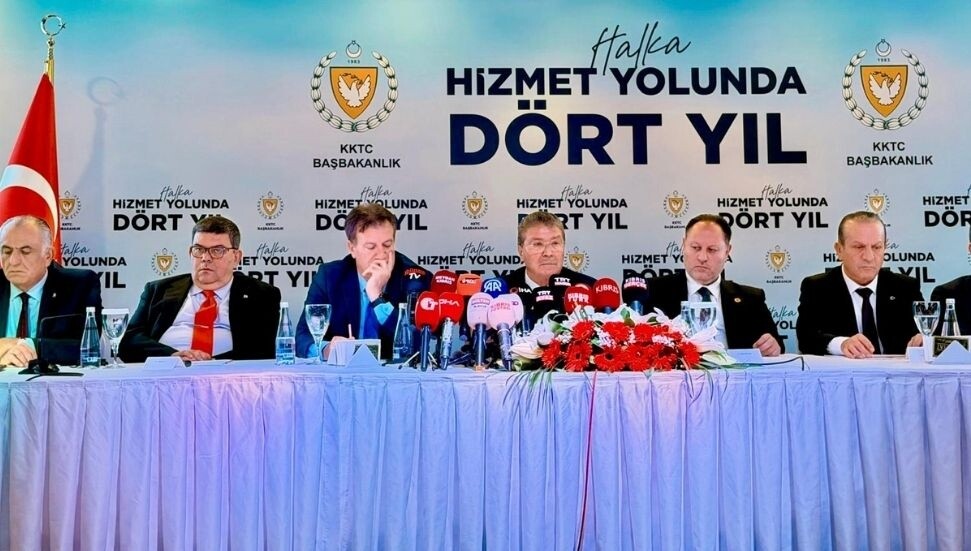
The meeting, held at the Grand Pasha Hotel in Nicosia, was attended by Speaker of the Assembly Ziya Öztürkler, Prime Minister Üstel, Deputy Prime Minister and Minister of Tourism, Culture, Youth and Environment Fikri Ataoğlu, Minister of Public Works and Transport Erhan Arıklı, cabinet members, MPs from the National Unity Party and independents, party-affiliated mayors and senior officials.
Üstel said the government had completed three years and eight months in office, describing it as one of the longest-serving administrations in the TRNC. He thanked coalition partners and MPs for their support, adding that the government had remained intact throughout its term.
“We have achieved most of our targets. We did not produce slogans; we produced work. We are a government of action and reform,” Üstel said, noting that despite economic volatility and inflation, efforts were made to protect workers’ purchasing power. He cited wage increases in the public sector, pointing out that a university graduate’s entry-level gross salary had risen sharply since January 2022.
Turning to economic indicators, Üstel said per capita gross national income had increased from 12,245 US dollars in 2022 to 17,498 dollars in 2024, adding that figures for 2025 would be shared once finalised. He said resources had been created to meet obligations on time, producers had received promised support, and no one had been forced into delayed wage payments.
On healthcare, Üstel said strengthening infrastructure had been made a priority after years of postponed investments. He highlighted the foundation-laying of the Nicosia State Hospital, which will have a capacity of 320 beds, describing it as a long-term health guarantee for the public. He said the Kyrenia Hospital would open soon, the Güzelyurt Hospital—idle for years—was nearing completion, construction of the Karpaz State Hospital in Pamuklu was ongoing, and the Maraş Health Centre had been opened. He added that the ambulance fleet had expanded by 70 per cent and that digital systems had been introduced in pharmaceuticals and integrated with Social Insurance.
Üstel said 2026 would see several major healthcare projects come into service, stressing that “this is about service, not elections”.
Addressing local governance, Üstel said a historic reform had reduced the number of municipalities from 28 to 18, increasing their service capacity and financial stability. He said no municipality was currently facing a wage crisis. Village headmen’s salaries had been raised to 95 per cent of the gross minimum wage, 112 of 186 mukhtar buildings had been renovated, 582 expropriation files resolved with payments totalling around 1.05 billion TL, and the MAKS project was 90 per cent complete.
On internal security, Üstel said measures had been strengthened at entry and exit points, the Irregular Migration Combat Centre was operating effectively, and a security cooperation agreement with Turkey was being implemented. He also said special taxes on property sales to foreigners had created sustainable funding for the Immovable Property Commission (IPC), noting that roughly one-third of all IPC payments to date had been made during his term.
In housing, Üstel said the “First Home” loan scheme had helped many young people become homeowners, and that social housing projects had been revived after a quarter-century hiatus.
In education, Üstel said the government was progressing steadily toward its target of 40 new schools, with significant investment in infrastructure, technology and strengthening projects. He said schools had moved to full-day education two days a week and that 80 million TL had been allocated for student lunches. He added that oversight in higher education had been strengthened through YÖDAK.
On agriculture, Üstel described the sector as the backbone of the economy and a guarantee of food security. He said water had been delivered to the Güzelyurt Plain, cold storage projects launched, and citrus producers compensated for unsold produce. He said 3.2 billion TL in support payments had been made to agriculture and livestock in 2025, with 1.5 billion TL paid in insurance compensation. Infrastructure works worth 38.5 million TL had been completed in organised livestock zones.
In transport, Üstel said major long-delayed projects had been completed, including the Ercan Airport, which he described as modern and high-capacity, noting a 50 per cent rise in passenger numbers in its first two years. He cited the opening of the Lefke–Güzelyurt road, the Yenierenköy–Balalan road linking Karpaz, completion of the Nicosia North Ring Road, and extensive village road renewals.
Üstel also referred to progress in digital infrastructure, including the long-awaited fibre-optic project, the installation of earthquake monitoring stations, and expanded coastal radar coverage for maritime security.
In tourism, Üstel said the completion of the Kyrenia Ancient Harbour project after nearly 50 years had restored the area as a showcase destination. He highlighted international branding under the “Ada Kıbrıs” project, fixed-price airfare agreements with Turkish Airlines and AJet, and the renovation of archaeological sites.
On social policy, Üstel said services had been expanded for women affected by violence, care homes renovated or planned, and an autism centre opened. He said the aim was to build a social state that left no one behind.
Concluding, Üstel said coordination between ministries had been strengthened, oversight increased, and the BİMER system introduced to give citizens direct access to the state. He said major investments had been made in the energy sector, including upgrades to power plants, transmission lines and substations, while acknowledging ongoing challenges. He said further “historic steps” for Kıb-Tek were expected following talks in Ankara.
Üstel also announced plans for a 12,000-seat FIFA-standard football stadium in the Nicosia area, alongside upgrades to existing sports facilities.
Comments
Attention!
Sending all kinds of financial, legal, criminal, administrative responsibility content arising from illegal, threatening, disturbing, insulting and abusive, humiliating, humiliating, vulgar, obscene, immoral, damaging personal rights or similar content. It belongs to the Member / Members.