

Christodoulides: Cyprus Proved the EU can be Truly Autonomous
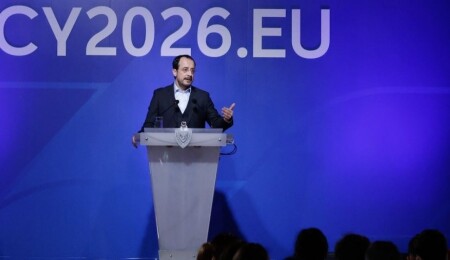
Cyprus proved that European strategic autonomy is real, President Nikos Christodoulides said on Wednesday, arguing that the allied military response to the recent drone strike on the British bases at Akrotiri demonstrated that the EU’s mutual defence clause works in practice.
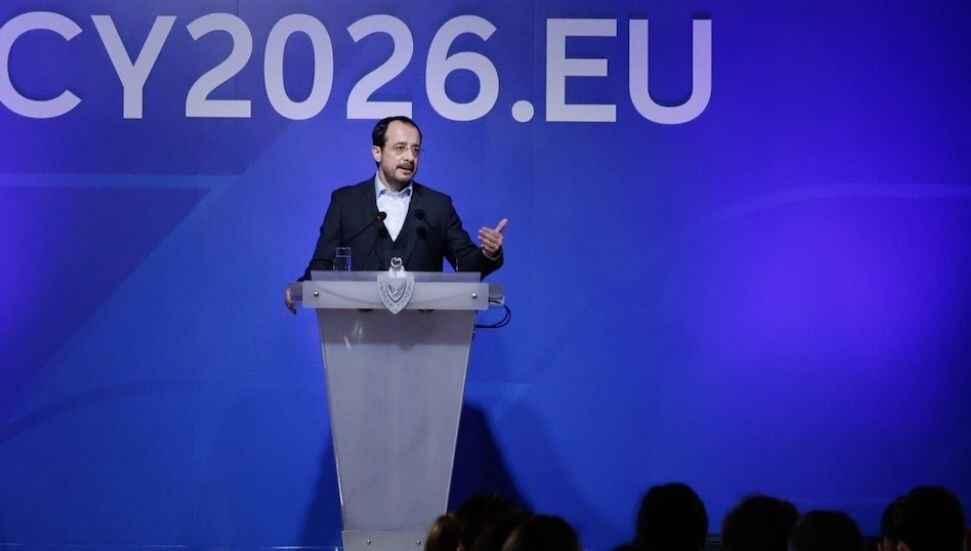
Speaking at the European Policy Centre in Brussels at the midpoint of the Cyprus Presidency of the Council of the EU, Christodoulides was direct about the limits of Cyprus’s involvement in the regional conflict. “Cyprus is not part of the conflict unravelling in the region,” he said. “We had a single, isolated incident with a drone at the British bases.”
What followed that incident, he argued, was historic. Greece, France, Italy, Spain, and the Netherlands responded immediately to his request and deployed forces and personnel to reinforce Cyprus’s defence. “Cypriots will never forget this act of valiant solidarity — it deeply touched Cypriots,” he said.
Although Article 42(7) of the EU Treaty — which obliges member states to aid any member state subjected to armed aggression — was not formally invoked, Christodoulides said Cyprus had effectively put it to the test. “We may not have triggered Article 42(7), but Cyprus essentially tested it. Successfully so. And that can be the beginning of something much greater for our Union,” he said.
He added that the episode had exposed a gap Europe must now fill: not only must member states be able to invoke the clause, but the EU must also have the mechanisms in place to implement it swiftly when the moment comes.
The Presidency, Christodoulides said, has been working to advance that readiness. Member states’ national plans under the SAFE programme have been approved, and the Presidency is pushing to conclude the Defence Readiness omnibus package and reach a general approach at the June Foreign Affairs Council (Defence) on a Military Mobility Package — aimed at removing the regulatory, infrastructure and capability barriers that slow cross-border military deployments.
On enlargement, which Christodoulides called the EU’s most successful foreign policy tool, he said two intergovernmental conferences for Montenegro have already taken place and work is under way to establish the ad hoc working party to draft Montenegro’s Accession Treaty. Progress on Albania’s Interim Benchmark Assessment Reports is also advancing, paving the way for the closure of the first chapters. Front-loading of accession work for Ukraine and Moldova is moving at pace, with informal ministerial meetings under the Cyprus Presidency taking place in Brussels later this week.
On the economy, Christodoulides sought to reassure that the regional conflict had not destabilised Cyprus. He said growth for 2026 is estimated at around 4%, conditions of full employment prevail, youth unemployment is among the lowest in the EU, and public debt is estimated at approximately 50% of GDP.
Cyprus’s long-standing role in the region, he said, remains a humanitarian one: “a safe haven — always part of the solution, never part of the problem.” That role will be on display in April, when Cyprus hosts an informal European Council bringing together EU leaders and partners from the wider Middle East to discuss concrete regional cooperation projects.
Comments
Attention!
Sending all kinds of financial, legal, criminal, administrative responsibility content arising from illegal, threatening, disturbing, insulting and abusive, humiliating, humiliating, vulgar, obscene, immoral, damaging personal rights or similar content. It belongs to the Member / Members.