

EU Tells Turkey Progress in Trade Ties Requires Steps Toward Cyprus
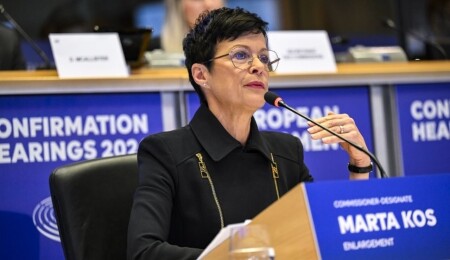
European Commissioner for Enlargement Marta Kos said the European Union needs Turkey in light of changing regional and global dynamics, but stressed that progress in relations would require concrete steps from Ankara, including on Cyprus.
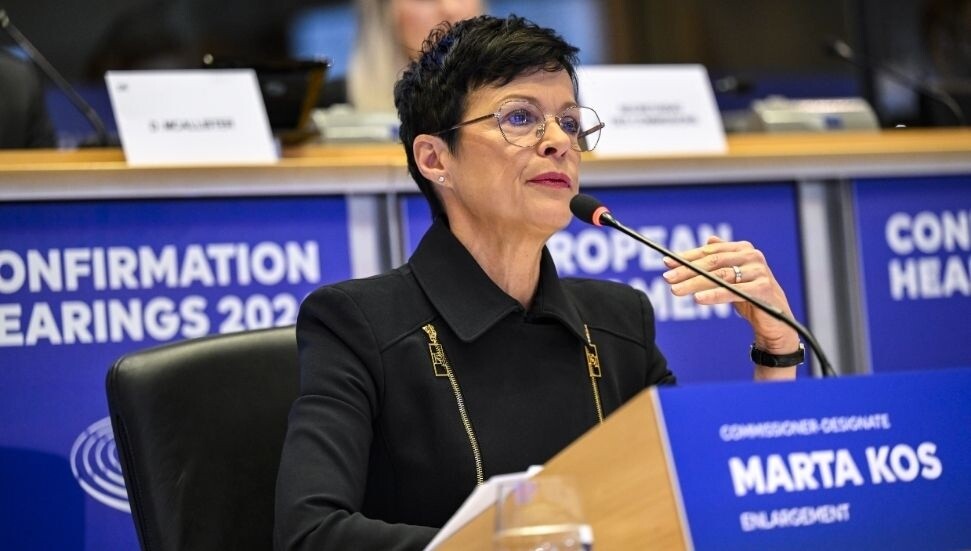
Speaking at the European Parliament on Monday, Kos said Turkey should be seen not only as a candidate country but also as a strategic partner for the EU.
“In light of the changing geopolitical realities in Europe and the Middle East, we need Turkey,” she said, emphasizing the importance of stronger partnerships in the EU’s immediate neighborhood.
Kos said her recent contacts with Turkey, as well as Armenia and Azerbaijan, should be understood in that context, adding that “we need to take bolder steps to build stronger alliances.”
She also highlighted Turkey’s economic importance, describing it as the EU’s fifth-largest trading partner and noting that EU-Turkey trade volume is twice the size of trade with Mercosur or India.
Kos underlined Turkey’s key role in trade routes linking Europe and Asia, as well as its strategic importance in the context of the war in Ukraine and Black Sea security.
“Any peace arrangement for Ukraine will require Turkey,” she said, pointing to Ankara’s role in the region and the fact that Turkey has NATO’s second-largest army.
She added that trade corridors developing through Turkey and the South Caucasus have become even more critical while war continues both to the north and south, noting that cargo transport along this route has quadrupled since 2022 and could triple again by 2030 with the right investments.
“We Expect Steps Toward Us and Cyprus”
Referring to her February visit to Turkey, Kos said Brussels and Ankara had agreed to explore ways to reduce trade barriers.
However, she made clear that progress would not be one-sided.
“We also expect steps from Turkey toward us and toward Cyprus,” she said, signaling that the EU expects concrete reciprocity from Ankara.
Six Remaining Criteria for Visa Liberalisation
Kos’s remarks came as debate continues over visa liberalisation for Turkish citizens.
According to a Turkey report published in May 2025 by European Parliament rapporteur Nacho Sanchez Amor, the visa liberalisation process could restart once Turkey fulfills the remaining six of the 72 required benchmarks.
Turkey has already completed 66 of the 72 conditions for visa-free travel to the Schengen area, but deadlock remains over the final six.
These include amendments to anti-terror legislation, an operational cooperation agreement with Europol, implementation of anti-corruption recommendations from GRECO, judicial cooperation with all EU member states on criminal matters, full implementation of the Readmission Agreement for irregular migrants, and aligning personal data protection laws with European standards.
The report stated that the European Parliament would support launching the visa liberalisation process “as soon as the six outstanding criteria are fully met in a non-discriminatory manner toward all EU member states.”
Enlargement Linked to Europe’s Security
Kos said enlargement is no longer only a technical accession process, but has become directly linked to Europe’s security and political future.
Following Russia’s war against Ukraine, she said peace, stability and democracy in Europe can no longer be taken for granted.
“For this reason, enlargement is no longer only about completing the European project, but also about securing it,” she said.
Kos argued that the EU must offer candidate countries a credible path forward while maintaining full compliance with reform standards and EU rules.
She described 2025 as “a good year” for enlargement, pointing to progress by Montenegro, Albania, Ukraine and Moldova, while voicing concern over democratic backsliding in Georgia and Serbia.
Concluding her remarks, Kos said enlargement remains one of the EU’s most strategic policies and called for courage, unity and vision in addressing Europe’s current challenges.
Comments
Attention!
Sending all kinds of financial, legal, criminal, administrative responsibility content arising from illegal, threatening, disturbing, insulting and abusive, humiliating, humiliating, vulgar, obscene, immoral, damaging personal rights or similar content. It belongs to the Member / Members.