

New Cyprus Settlement Plan Reportedly Being Explored

A new Cyprus settlement framework is reportedly being explored by the United Nations, according to Politis newspaper editor Dionysis Dionysiou, who claims discussions are under way on a model that would combine elements of both federation and confederation while offering incentives to both sides.
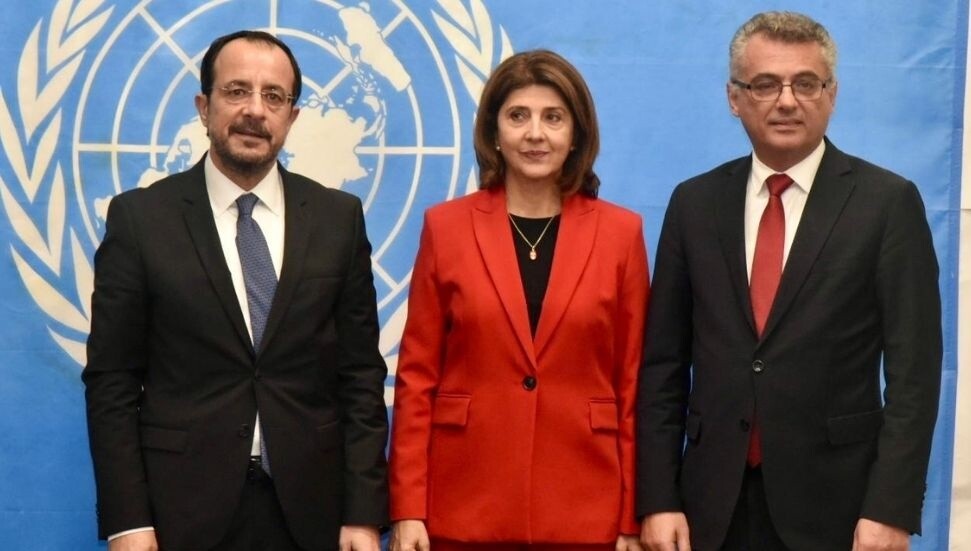
Dionysiou wrote that the UN is preparing for a new expanded five-plus-one conference later this year and is considering presenting the parties with a fresh settlement outline. According to the report, UN Secretary-General's Personal Envoy for Cyprus, Maria Angela Holguin, has adopted a more active approach than previous mediators, holding contacts not only with political leaders but also with politicians, academics, civil society representatives, guarantor states and European Union officials.
He argued that the objective is not to revive previous negotiation frameworks but to develop a model that is concrete enough to bring the sides back to the table while remaining flexible enough to avoid immediate rejection.
A Model Between Federation And Confederation
According to Dionysiou, the framework under discussion differs from previous federal models and is based on a looser European-style partnership.
He claimed that the Greek Cypriot side could interpret the arrangement as a bi-zonal, bi-communal federation, while the Turkish Cypriot side could view it as a model closer to confederation. The aim, he suggested, is to bridge the gap between Greek Cypriot support for federation and Turkish Cypriot demands for sovereign equality and equal international status.
Territorial Adjustments In Exchange For Direct Trade And Flights
Dionysiou claimed that the emerging framework centres on a balance between territorial concessions and political recognition.
Based on maps discussed during the Crans-Montana talks, areas such as Varosha, Morphou and parts of the Mesaoria region could reportedly be revisited in negotiations. In return, Turkish Cypriots could receive long-sought measures including direct trade, direct contacts and direct flights.
According to the report, a transition period of two to three years is also being considered. During that period, territorial adjustments could begin, particularly in Varosha, while confidence-building measures benefiting Turkish Cypriots would be gradually implemented.
The article further claimed that opening Turkish ports to Republic of Cyprus-flagged vessels and easing certain airspace restrictions could also form part of a broader package.
Reduced Central Powers
The proposed structure would reportedly limit the powers of the central government significantly.
Instead of a strong federal administration, most day-to-day governance responsibilities would be delegated to the two constituent states. The central authority would focus primarily on foreign representation, European Union affairs, fiscal coordination and security.
The model is said to include two constituent states, two legislative chambers and a joint body responsible for federal matters. One option reportedly under discussion is a shared institution composed of Greek Cypriot and Turkish Cypriot representatives rather than a directly elected federal parliament.
Rotating Presidency Council
Dionysiou also claimed that one scenario under discussion involves a rotating presidency council.
Under this arrangement, the leaders of the two communities would alternately head the executive branch, with rotation ratios reportedly ranging from two-to-one to three-to-one in favour of the Greek Cypriot side.
The article further suggested that Greek Cypriot leader Nikos Christodoulides may be open to a model featuring a largely symbolic rotating federal presidency while executive authority remains concentrated in a Greek Cypriot prime minister. Dionysiou argued, however, that the Turkish Cypriot side would only consider such an arrangement if accompanied by robust political equality mechanisms.
Positive Vote Mechanism Returns To Debate
The report also claimed that the long-debated formula requiring at least one positive vote from a Turkish Cypriot minister on key decisions has resurfaced in discussions.
While the Turkish Cypriot side reportedly views the mechanism as essential for genuine political equality, the Greek Cypriot side remains concerned that it could lead to institutional deadlock.
One compromise reportedly under consideration would restrict the requirement to issues of vital importance or introduce mechanisms designed to overcome potential impasses.
NATO Option Discussed For Security Arrangements
On security and guarantees, Dionysiou claimed that the Greek Cypriot side continues to favour the abolition of the 1960 system of guarantees, while the Turkish Cypriot side insists on maintaining a Turkish military presence on the island.
According to the report, the United Nations is examining a possible middle-ground solution involving NATO. Under such a model, Cyprus could potentially join NATO, with Turkish, Greek, British, French and American forces participating in a broader security framework.
Natural Gas And Turkey-EU Relations
Dionysiou argued that the settlement process is no longer solely a negotiation between the two communities.
He claimed that Turkey is seeking progress in its relations with the European Union, particularly regarding the Customs Union, and sees potential benefits in a Cyprus settlement.
The article also suggested that a settlement could unlock new opportunities for cooperation in the energy sector. According to Dionysiou, Turkey has signalled its readiness to construct pipelines for the transportation of Cypriot natural gas and could become a significant purchaser of future gas exports.
Erhürman Seen As More Ready Than Christodoulides
The columnist also assessed the positions of the two leaders.
According to Dionysiou, Turkish Cypriot leader Tufan Erhürman appears more prepared to engage with such a framework, while Nikos Christodoulides is adopting a more cautious approach.
He argued that one of the main challenges facing the Greek Cypriot leadership would be convincing public opinion that a looser federal arrangement would not evolve into a confederal or partition-based structure.
“Holguin Is Trying To Change The Paradigm”
Dionysiou concluded by arguing that Holguin is not attempting to revive previous negotiating frameworks but is instead seeking to establish an entirely new paradigm.
According to his analysis, neither a return to the point where negotiations ended in 2017 nor a fully fledged two-state solution appears politically realistic at present.
For that reason, he suggested that the model currently being discussed seeks to create a more flexible European-style arrangement positioned somewhere between federation and confederation, with future developments likely to determine whether such an approach can gain support from the parties involved.
Comments
Attention!
Sending all kinds of financial, legal, criminal, administrative responsibility content arising from illegal, threatening, disturbing, insulting and abusive, humiliating, humiliating, vulgar, obscene, immoral, damaging personal rights or similar content. It belongs to the Member / Members.