

EU window dressing in amateur football: Building trust or just putting on a show?
The European Union’s portrayal of a mixed-team match involving two amateur clubs as an initiative for trust and reconciliation raises questions about the gap between its stated ambitions and the activity itself. Following the Barcelona football camp controversy, the EU Infopoint faces a clear question: What did you do to defend trust and the unifying power of sport when those tensions arose?
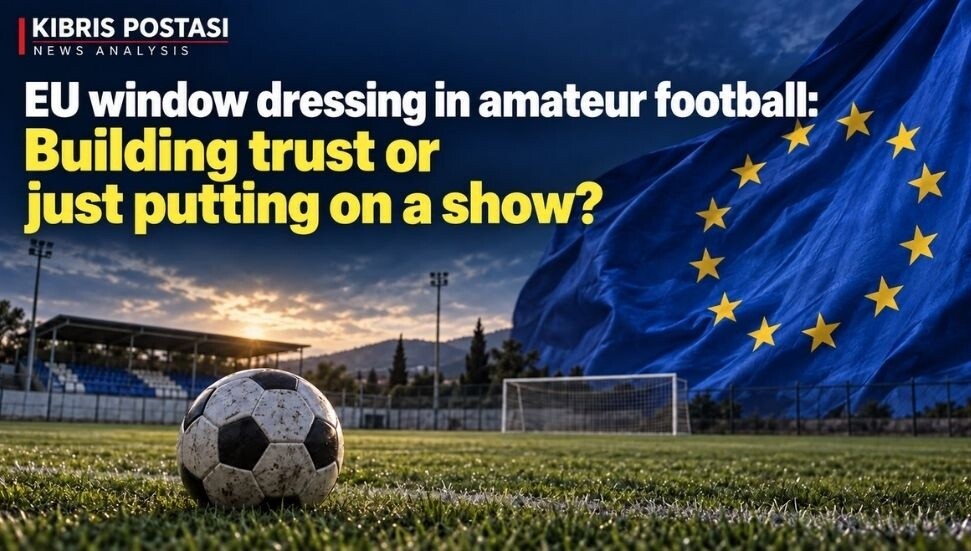
Players from Yenikent Perçinci Football Club, a member of the BTM amateur football league, and APOLLON Geriou, from the Greek Cypriot community’s POEL amateur football league, met at Latsia Stadium in Nicosia on Saturday, 19 September 2026, for a friendly event supported by the European Union through the EU Infopoint.
According to the event announcement, the players formed two mixed teams rather than competing as their respective clubs. Club members, supporters, players and their families gathered after the match.
The event was presented as an initiative aimed at strengthening trust, teamwork, mutual respect and reconciliation between the Turkish Cypriot and Greek Cypriot communities.
Yet, alongside these ambitious objectives, one question remained unanswered: What lasting cooperation would this gathering produce?
WHERE WERE YOU DURING THE BARCELONA CONTROVERSY?
Greek Cypriot objections to Barcelona’s planned football camp in northern Cyprus, followed by its postponement, brought renewed attention to how easily sport can become entangled in political tensions.
As efforts by Cyprus Football Association (KOP) President Haris Loizidis to challenge the camp became public, children’s participation in a football programme stood at the centre of the dispute.
That raises a direct question for the EU Infopoint, which now speaks of football bringing communities together: Where were you during the Barcelona controversy?
What steps did you take to help children participate in an international football programme? How did you defend the principles of trust, mutual respect and reconciliation that you emphasise today?
If the EU Infopoint undertook any work during that dispute, it should explain what it did. The credibility of its message about sport’s unifying power depends on the position it takes when tensions arise.
IS THE EU BEING SOLD A SUCCESS STORY?
The event also deserves scrutiny from the perspective of the European Union and the quality of the initiatives it supports.
Presenting a social gathering between two amateur clubs as a substantial trust-building initiative risks creating a misleading impression of its impact. The EU Infopoint’s approach is open to the criticism that it prioritises the appearance of activity while pushing the scale of the underlying problems into the background.
This is where the risk of misleading the EU itself arises: Holding an event and achieving an outcome are not the same thing. Organising a match does not, in itself, demonstrate that lasting trust has been built between communities.
Without an explanation of which barrier has been overcome, which institutional relationship has been established and what will happen next, what remains is a limited activity promoted in ambitious language.
THE REAL TEST IS BRINGING THE FEDERATIONS TOGETHER
If the EU wants to support lasting rapprochement through football, it should aim to bring first-division clubs together under their own names and in their own shirts, through cooperation between the two sides’ football federations.
Such an initiative would require institutional engagement, shared responsibility and continuity. Its success could be measured through regular fixtures, joint activities and sustained relationships.
A concrete step in that direction, backed by the EU, would give its trust-building message greater substance.
The event announcement, however, contains no process involving the federations, no programme of regular fixtures between clubs and no timetable for either.
WHICH BARRIER DID MIXED TEAMS OVERCOME?
The decision to place players in mixed teams rather than have them compete as their own clubs also warrants scrutiny.
Mixed teams can encourage communication and give players experience of working together. But they cannot replace sporting relationships between clubs acting under their own identities, or shared responsibility between football federations.
Presenting this format alone as a significant achievement in reconciliation overstates the event’s significance. The way to overcome the criticism that this is merely a show of activity is to announce a concrete programme extending beyond the match.
A SOCIAL GATHERING IS NOT A MAJOR POLITICAL ACHIEVEMENT
Players and families meeting and forming new friendships is, of course, valuable. The targets of this criticism are neither the footballers who took to the pitch nor the families who attended.
What is being questioned is the significance the EU attaches to the gathering, and the gap between its stated objectives and the scale of the activity delivered.
Building trust and reconciliation between communities is a responsibility that cannot be fulfilled simply by bringing families together after a match.
The EU Infopoint should explain what action it took during the Barcelona controversy and what it intends to do next to bring football together at an institutional level.
Trust-building is measured by barriers overcome, lasting relationships established and consistency shown in difficult times—not by event photographs and promotional statements.
Comments
Attention!
Sending all kinds of financial, legal, criminal, administrative responsibility content arising from illegal, threatening, disturbing, insulting and abusive, humiliating, humiliating, vulgar, obscene, immoral, damaging personal rights or similar content. It belongs to the Member / Members.