

Erhürman: I Expect Christodoulides to Accept Rotating Presidency in Principle
President Tufan Erhürman has said he expects Greek Cypriot leader Nikos Christodoulides to state that he accepts rotating presidency in principle, adding that he has not received a document containing 19 points. Erhürman also firmly denied claims that he rejected a proposal on Varosha following intervention by Ankara.
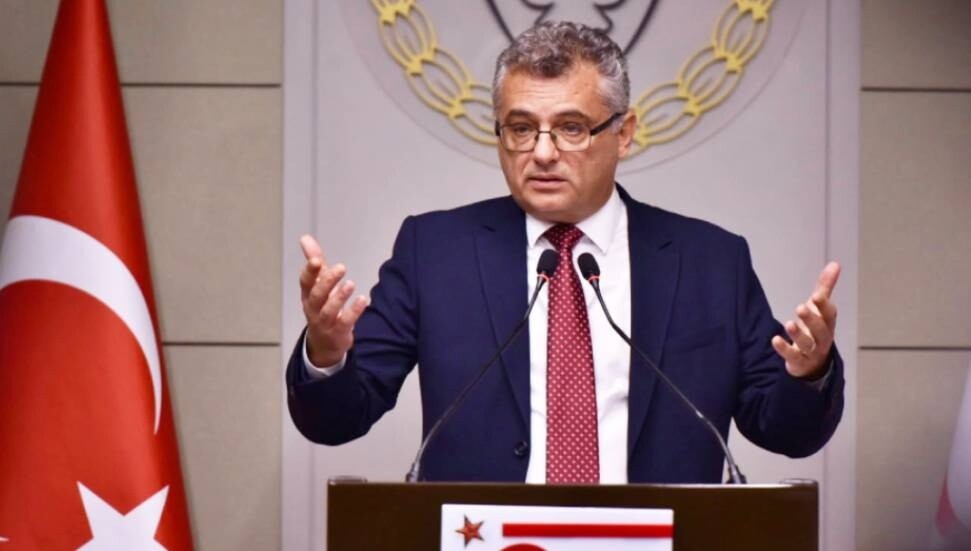
In an exclusive interview with Politis, the first part of which was published in its latest edition, Erhürman said he had received no written document containing 19 points from Christodoulides, either directly or indirectly. He also rejected claims that he had turned down a proposal concerning Varosha at Turkey’s request and said he had not accepted any of the four points in the Greek Cypriot side’s proposed methodology.
In the introduction to the interview, journalist Andreas Parashos wrote that Erhürman regards acceptance of rotating presidency as a prerequisite for the resumption of negotiations, rejects linking rotating presidency to the issue of guarantees, and holds the Greek Cypriot side responsible for the lack of progress on opening new crossing points, citing its changing demands.
Asked what kind of settlement he favours, Erhürman said that “content is more important than labels.” He also said he was ready to continue close cooperation with Christodoulides, particularly on confidence-building measures (CBMs) proposed by UN Secretary-General António Guterres.
“I HAVE NOT RECEIVED A 19-POINT DOCUMENT”
Politis recalled that the Greek Cypriot administration had announced that Christodoulides had submitted a 19-point document outlining ideas focused on the core of the Cyprus problem, methodology and CBMs. The newspaper asked Erhürman whether he had received such a document.
Erhürman began by saying that diplomatic courtesy prevented him from disclosing to the media what his interlocutor had said or proposed during their meetings. However, he stressed that this did not prevent him from stating that he had received no such written document, either directly or indirectly.
“Just as in our previous meetings, various issues were raised during our latest meeting. We exchanged views on them, and I also raised some issues of my own. If these matters are made public, I can comment on them without violating my own principles. However, we must not lose sight of the effort we are engaged in. The issue is not how many proposals each side has put forward. We are not in a competition in which the side making more proposals wins. Nevertheless, during the 11 months since my election, I have put forward various proposals of mutual benefit, starting with my 10-point proposal on CBMs,” he said.
Erhürman noted that the UN Secretary-General’s term was nearing its end and that, during his visit to the island, Guterres had proposed working on various CBMs. Erhürman said he had accepted almost all of them and expressed his readiness to discuss crossing points further.
“The Secretary-General appears to have selected specific proposals because he believes they have a greater chance of success. We should therefore focus on reaching agreement on the tasks he has left us and try to make progress,” he said.
“Is there any reason to make the situation even more complicated? Given the work ahead of us and the time available, it is not productive to multiply the issues that need to be resolved. I want us to focus on the CBMs proposed by the Secretary-General without restrictions so that we can make as much progress as possible. I want to continue close cooperation with Niko in this direction. However, above all, we expect actions that undermine trust to stop,” he added.
CLAIM THAT HE REJECTED THE VAROSHA PROPOSAL
Asked about claims that Christodoulides had proposed returning Varosha under UN administration in exchange for opening Famagusta Port under European Commission supervision, and that Erhürman had rejected the proposal following intervention by Ankara, the president said the question concerned allegations reported in the media.
Reiterating his principle of not commenting on what his interlocutor had said during their meetings, Erhürman said the issue had existed for decades and that both sides’ positions were well known.
“The real question is whether launching a public debate on this issue, particularly at this moment, would help us make progress on the less complicated CBMs we have been working on for a long time,” he said.
Erhürman noted that the two leaders had failed to open even a single crossing point in 11 months and questioned whether it was realistic to expect them to resolve such sensitive and important issues in the remaining two and a half months.
“Nevertheless, I can give a very clear answer to the claim that I initially accepted such a proposal and then rejected it following intervention. My answer is an unequivocal ‘No.’ If the Greek Cypriot leadership is trying to portray Turkey, rather than the Turkish Cypriot leadership, as its interlocutor, this is not merely wrong but misleading, and constitutes another action that damages trust,” he said.
“NONE OF THE FOUR METHODOLOGY POINTS HAS BEEN ANSWERED”
Politis reminded Erhürman of reports in the Greek Cypriot press claiming that he had accepted three of the four proposals put forward by Christodoulides for restarting negotiations. The newspaper asked why he was unwilling to proceed on the basis of the three points that Christodoulides was reportedly ready to accept.
Erhürman said he had not yet responded to any of the four points in the Greek Cypriot side’s proposed methodology, adding that claims that three of the four had been accepted were incorrect and misleading.
He explained that the first point in his proposed methodology concerned political equality, with rotating presidency being one of its main components.
“So far, I have not heard the Greek Cypriot leader say, ‘I accept rotating presidency in principle.’ The specific arrangements governing rotating presidency will, of course, be subject to negotiations. What needs to be accepted now is the principle,” he said.
Erhürman stressed that his four methodological points should not be described as preconditions.
“They codify the UN Secretary-General’s repeated assessment that ‘this time must be different.’ We developed this methodology by learning lessons from previous failed attempts, with the aim of preventing a repetition of the past. It is therefore intended to significantly increase the prospects of achieving a settlement at the end of a new process. These issues concern the process, not the substance. At the end of his latest visit, the Secretary-General acknowledged in his press statement that an agreement on methodology was necessary,” he said.
“WE HAVE NOT OPENED A SINGLE CROSSING POINT”
Erhürman was asked why no new crossing points had been opened despite Christodoulides saying on July 29 that he was ready to open additional crossings.
The president said there had been a genuine opportunity to open four crossing points — Haspolat, Akıncılar, Kiracıköy–Gaziler and Eylence — following the informal expanded meeting in New York.
“However, whenever we believe we are ready to clarify the issue, the circumstances change, and we have so far failed to open even a single crossing point. Attempts to add or remove items from the package at the last minute certainly do not help. Nevertheless, I have put forward various alternative proposals to address the Greek Cypriot side’s demands and help move the issue forward,” he said.
Erhürman said he had proposed building a new road north of the existing route to serve the Gaziler and Eylence crossings, with the Turkish Cypriot side covering the cost. The proposal was rejected on the grounds of land ownership, he said.
“To address this concern, I suggested to Niko that any claim could be dealt with through the Immovable Property Commission. This was also rejected,” he said.
He added that the Turkish Cypriot side had subsequently proposed constructing a new road in the south. On his own initiative, he obtained confirmation that the European Union was prepared to provide funding and proposed that the two leaders jointly apply to the EU for the funds.
“This could have given this CBM symbolic significance. Unfortunately, it was rejected once again,” he said.
Erhürman argued that his interlocutor had chosen to insist on his own position rather than examine any of the proposals.
“Nevertheless, I remain committed to continuing to work sincerely on this very important CBM within an agreed framework because I know it would have an immediate positive impact on the daily lives of both Turkish Cypriots and Greek Cypriots,” he added.
“CONTENT IS MORE IMPORTANT THAN LABELS”
Asked whether he currently favoured a bi-zonal, bi-communal federation or another form of settlement, Erhürman said labels would not help achieve a mutually agreed, fair and sustainable solution.
“After what happened and what was said at Crans-Montana, I believe using labels will not help us achieve our main objective: a mutually agreed, fair and sustainable settlement. I said this even before my election last October. Content is more important than labels. Labels can often be misleading. The content will determine the type of settlement we reach,” he said.
He stressed that the immediate priority should be to establish a framework that would allow the parties to enter full-fledged negotiations and discuss substantive issues in depth and detail.
“Focusing on labels has not brought us closer to a settlement so far. A path to a settlement that ensures the security and prosperity of future generations on our island is possible only through political equality that takes into account the legitimate rights and concerns of both Turkish Cypriots and Greek Cypriots. That is why this is the first point in my proposed methodology,” he said.
“Labels did not bring us to a settlement in either 2004 or 2017. What matters is not the labels but the content. If we cannot agree on the substance, using labels will not take us where we want to go,” he added.
“WE CANNOT APPROACH EVERYTHING AS A GIVE-AND-TAKE PROCESS”
Asked whether he believed substantive negotiations should involve genuine give-and-take, Erhürman said this was one method used to resolve conflicts and could be applied at any stage of dialogue, including the current efforts on CBMs.
“However, we cannot approach everything as a give-and-take process. Reciprocity is not always the issue. My guiding principle is to adopt an approach based on mutual benefit,” he said.
“ROTATING PRESIDENCY CANNOT BE LINKED TO GUARANTEES”
Asked whether rotating presidency could be exchanged for ending or fundamentally changing the system of guarantees, Erhürman said he did not believe the two issues could be linked.
“These two issues are very different in both form and substance. Political equality, together with its essential elements, belongs to the process, as I have emphasised in my methodology. The second issue concerns the substance. This is precisely why I have not included security and guarantees in my proposed methodology,” he said.
He stressed, however, that this did not mean security and guarantees were unimportant to Turkish Cypriots, particularly in light of recent developments in the region and the Greek Cypriot side’s insistence on concluding military agreements with third parties without Turkish Cypriot consent.
“On the contrary, the issue of security and guarantees is of great importance to my people,” he said.
Erhürman went on to explain why he regarded political equality as a procedural issue rather than one concerning the substance of a settlement.
“The fundamental reason all previous efforts failed was the lack of willingness on the Greek Cypriot side to share power and prosperity with Turkish Cypriots. The Greek Cypriot side’s reluctance to accept political equality, including rotating presidency, became evident during the negotiations,” he said.
He argued that, as the UN Secretary-General had also proposed, the issue should be accepted at least in principle before negotiations began to ensure that the new process would genuinely be different.
“This would allow us to engage in a results-oriented process that could finally lead to a settlement, unlike in 2004 and 2017,” he said.
“Political equality is therefore not a matter for give-and-take; it is at the heart of the issue. If we fail to reach agreement on the substance, we will not achieve a settlement. I do not want to disappoint once again the hopes of Turkish Cypriots and Greek Cypriots who want a solution. On the contrary, I want to launch a process that will lead to a settlement this time,” he added.
“I CANNOT SPEAK ON BEHALF OF TURKEY”
In the final question published in the latest instalment of the interview, Politis asked whether Turkey was genuinely ready to resolve the Cyprus problem or whether it was linking the issue to other matters, including Turkey–EU relations, energy and regional interests.
Erhürman said the question should be addressed to Turkey itself and stressed that he could not speak on its behalf.
“However, everyone knows that Turkey did its best in both 2004 and 2017,” he said.
He added that attempts to link a settlement of the Cyprus problem with Turkey–EU relations would complicate two separate processes, each with its own dynamics.
“Moreover, it should not be forgotten that the Greek Cypriot side is part of the EU together with Greece, while the Turkish Cypriot side and Turkey are not. Under these circumstances, establishing such a link would make the situation even more competitive,” he said.
“I hope these two separate processes proceed along their own paths and produce results. Although there is no inherent link between them, progress in both processes could certainly help create positive momentum,” Erhürman added.
Comments
Attention!
Sending all kinds of financial, legal, criminal, administrative responsibility content arising from illegal, threatening, disturbing, insulting and abusive, humiliating, humiliating, vulgar, obscene, immoral, damaging personal rights or similar content. It belongs to the Member / Members.